Brain Body
Behind the comic
What is your research about - in one sentence?
We study how signals from the body, such as the heartbeat and breathing, interact with the brain to shape how we perceive and interact with the world.
What does the comic show?
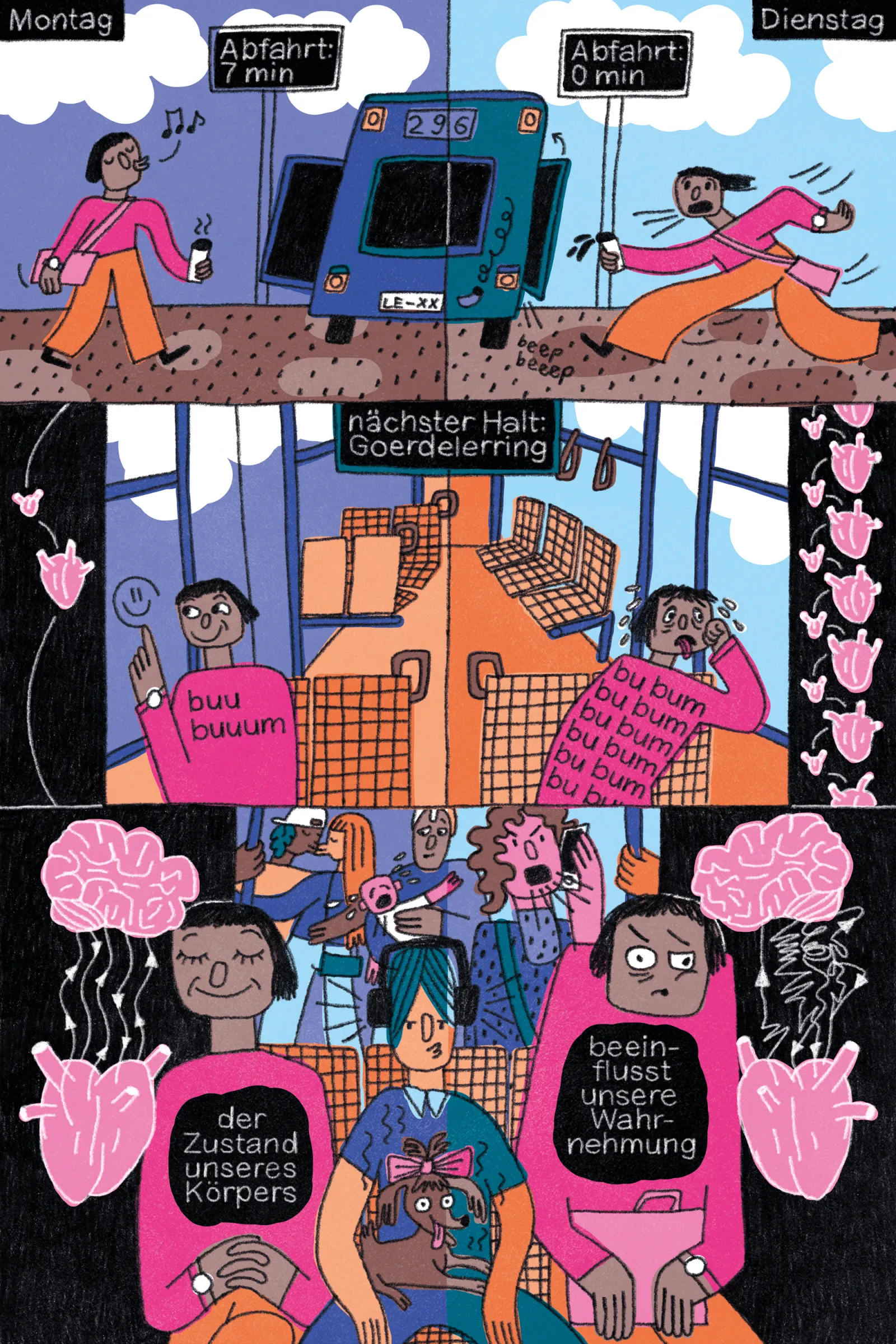
Our comic uses stress combined with physical activity to show that thoughts and feelings do not come from the brain alone. We show how the same person might experience a busy bus differently on two different days, depending on the state of their body. On one day, the noise, movement, and crowding may feel manageable. On another day, if the person is tired, tense, hungry, or stressed, the same bus may feel overwhelming or even threatening.
This happens because the brain is constantly in conversation with the body. It does not only process the outside world; it also receives signals from inside the body and uses them to interpret what is happening around us. When the body shifts into stress, hormones such as cortisol and adrenaline prepare it for action by increasing alertness, heart rate, and energy availability. These changes can be useful, but they can also make everyday situations feel more intense.
Other organs also send information to the brain. The heart, gut, immune system, and hormones all help shape how we feel, think, and respond. Understanding this body-brain interaction may help future healthcare better connect physical and mental health.
What findings support this idea?
The evidence points to a simple but important idea: feelings are not produced by the brain in isolation. Brain regions that regulate the heart, breathing, and other bodily functions form the central autonomic network, which overlaps with systems for emotion, attention, and perception. In other words, circuits that keep the body in balance also help decide what feels important.
Studies from our lab add to this picture. With changing intensity and “flavors” of emotions, the balance between body and brain changes dynamically. For instance, when emotions run high, the body appears to communicate more to the brain than the brain does to the body.
Loneliness shows what can happen when this balance is disturbed. Not only does it hurt emotionally, but our subjective feeling of isolation can disrupt our usual bodily regulation. These bodily changes may then feed back into the brain, making a person more alert to social threat, more likely to withdraw, and less able to reconnect. Together, these findings suggest that perception, emotion, and decisions emerge from a dialogue between body, brain, and our environment.
What are the limits and common misunderstandings?
Research on brain-body interaction should not be interpreted as showing that the body alone determines what we think, feel, or do. Bodily signals are important, but they are only one part of a larger picture that also includes the brain, personal history, social context, and the surrounding environment.
A potential misunderstanding is that the same body signals always lead to the identical emotional or behavioural response. In reality, the same bodily state can be experienced differently by different people, or even by the same person in different situations. For example, a fast heartbeat may feel exciting in one context and frightening in another.
We also do not mean to say that mental health problems can be explained only by the body, or that people can simply “control” their emotions by controlling bodily signals. Body-brain communication is complex, and many mechanisms are still being studied. The findings should therefore be seen as showing how body and brain work together, rather than as a simple cause-and-effect explanation.
What questions are still unanswered?
Research on body-brain interactions has grown quickly over the last decade, but many questions are still unanswered. We now know that the brain constantly receives signals from the heart, lungs, gut, and other organs. These signals help shape how we perceive the world, how we feel, and how we make decisions. However, scientists are still trying to understand exactly how this communication happens moment by moment.
One major question is why body-brain communication differs between people and situations. For example, some people may be more sensitive to signals from inside their body, while others may notice them less. These differences could help explain why people experience the same situation in different ways.
Another important question is how changes in body-brain communication relate to health. In some conditions, people may find it difficult to sense what is happening inside their body, or they may become overly focused on bodily sensations. Both can influence emotions, thoughts, and wellbeing. Understanding these processes may help us better connect physical and mental health in the future.
How could this shape future medicine?
The same situation can feel very different depending on the state of the body. This idea could become important for the medicine of the future. By studying how the body and brain communicate, researchers may better understand why stress, tiredness, breathing, heart activity, hormones, or other bodily signals can change how we feel, think, and respond to the world.
In the future, this knowledge could help make care more personal. Instead of looking only at symptoms, doctors and therapists may also consider how a person’s body and brain interact in everyday life. It may also support prevention, by helping to identify early warning signs before problems become more severe.
For you, the message is also practical: the body is not just a passive container for the brain. Sleep, movement, stress, breathing, social connection, and physical health can all influence our mental life. This does not mean that people can simply “think” or “breathe” their way out of illness, but it can help us better understand ourselves and take body-brain health seriously.
What societal and ethical questions does this raise?
One opportunity is that healthcare could become more sensitive to the connection between bodily state and mental experience. This could support earlier help and more personal forms of care, especially when emotional distress and physical tension influence each other.
At the same time, this research needs to be handled carefully. It should not lead to the idea that people are responsible for illness because they have not managed their body “well enough.” Body-brain communication is shaped by many factors, including biology, environment, social conditions, and access to care. The aim should be to use this knowledge to support people, not to blame them or turn health into another personal performance task.
Social context should also remain part of the picture. Stress, loneliness, and exhaustion do not arise only inside the individual body, but often also through working conditions, social isolation, lack of recovery, or limited support. This research can therefore help strengthen individual strategies while also making the importance of supportive environments more visible.
How do you study this topic?
In order to study how the brain and body work together, we combine methods from neuroscience, psychophysiology and experimental psychology. In our studies, participants complete tasks designed to evoke emotions or social experiences, such as loneliness- or stress-related scenarios. They may also perform simple actions or make perceptual decisions, such as judging whether an image is tilted to the left or right. In some cases, we use virtual reality (VR) to create more realistic and everyday-like situations. While participants perform these tasks, we simultaneously record brain and bodily activity. Depending on the question, we measure brain activity using techniques like electroencephalography (EEG) and functional magnetic resonance imaging (fMRI), which capture how the brain is processing the task. At the same time, we track bodily responses such as heart activity using electrocardiography (ECG), breathing, and other markers of autonomic regulation, meaning processes that run automatically in the body. By combining these measures, we can study how the brain and body continuously influence each other, and in turn influence our perceptual, emotional and social experiences.
Where can I learn more about this topic?
An introduction to heart-brain communication aimed at young readers (ages 12-15) published on Frontiers for Young Mind: Gerosa M, Patyczek A, Reinwarth E and Gaebler M (2025) The Body’s Band: How Heart and Brain Communicate. Front. Young Minds. 13:1536787. doi.org/10.3389/frym.2025.1536787
Kwon, D. (2026, January 1). Disruptions in This Sixth Sense May Drive Mental Illness. Scientific American. https://www.scientificamerican.com/article/interoception-is-our-sixth-sense-and-it-may-be-key-to-mental-health/
Interozeption: Signale aus dem Körperinneren. (n.d.). Retrieved 12 June 2026, from https://www.spektrum.de/news/interozeption-signale-aus-dem-koerperinneren/1916227
Bayerischer Rundfunk. Interozeption—Signale aus dem Körperinneren—Radiowissen. BR Podcast. Retrieved 12 June 2026, from https://origin.podcast.br.de/mediathek/podcast/radiowissen/interozeption-signale-aus-dem-koerperinneren/2101714
References
Piejka, A., Wiśniewska, M., Thayer, J. F., & Okruszek, Ł. (2021). Brief induction of loneliness decreases vagal regulation during social information processing. International journal of psychophysiology : official journal of the International Organization of Psychophysiology, 164, 112–120. https://doi.org/10.1016/j.ijpsycho.2021.03.002
Fourcade, A., Klotzsche, F., Hofmann, S. M., Mariola, A., Nikulin, V. V., Villringer, A., & Gaebler, M. (2024). Linking brain–heart interactions to emotional arousal in immersive virtual reality. Psychophysiology, 61, e14696. https://doi.org/10.1111/psyp.14696
Gerosa, M., Haggard, P., Villringer, A., & Gaebler, M. (2026, April 23). Cardio-respiratory rhythms shape when we act and how we experience the outcomes of our actions. Retrieved from osf.io/preprints/psyarxiv/qzs6j_v1
Villringer, A., Nikulin, V. V., & Gaebler, M. (2025). Brain–body states as a link between cardiovascular and mental health. Trends in Neurosciences, 48(10), 766–779. https://doi.org/10.1016/j.tins.2025.08.004
Where it's set
About the Project
Science Streets ist ein Wissenschaftskommunikationsprojekt, das Wissenschaft in den Alltag bringt, indem es Leipzigs öffentliche Räume zu Lernorten macht. Für vier Wochen im August 2026 werden Science-Comics auf Werbeflächen (Litfaßsäulen, City-Light-Postern, Infoscreens, im öffentlichen Nahverkehr usw.) gezeigt. Das diesjährige Thema lautet Neurowissenschaften. Zehn Wissenschaftler*innen und zehn Illustrator*innen werden ausgewählt, um gemeinsam Comics rund ums Gehirn zu gestalten – die Wissenschaftler*innen liefern die Inhalte, die Illustrator*innen setzen diese künstlerisch um.
Videos
More Comics