Cerebellum
Behind the comic
What is your research about - in one sentence?
We study how the once overlooked “little brain” (the cerebellum) plays a big role in how we move, think, communicate, and regulate emotions.
What does the comic show?
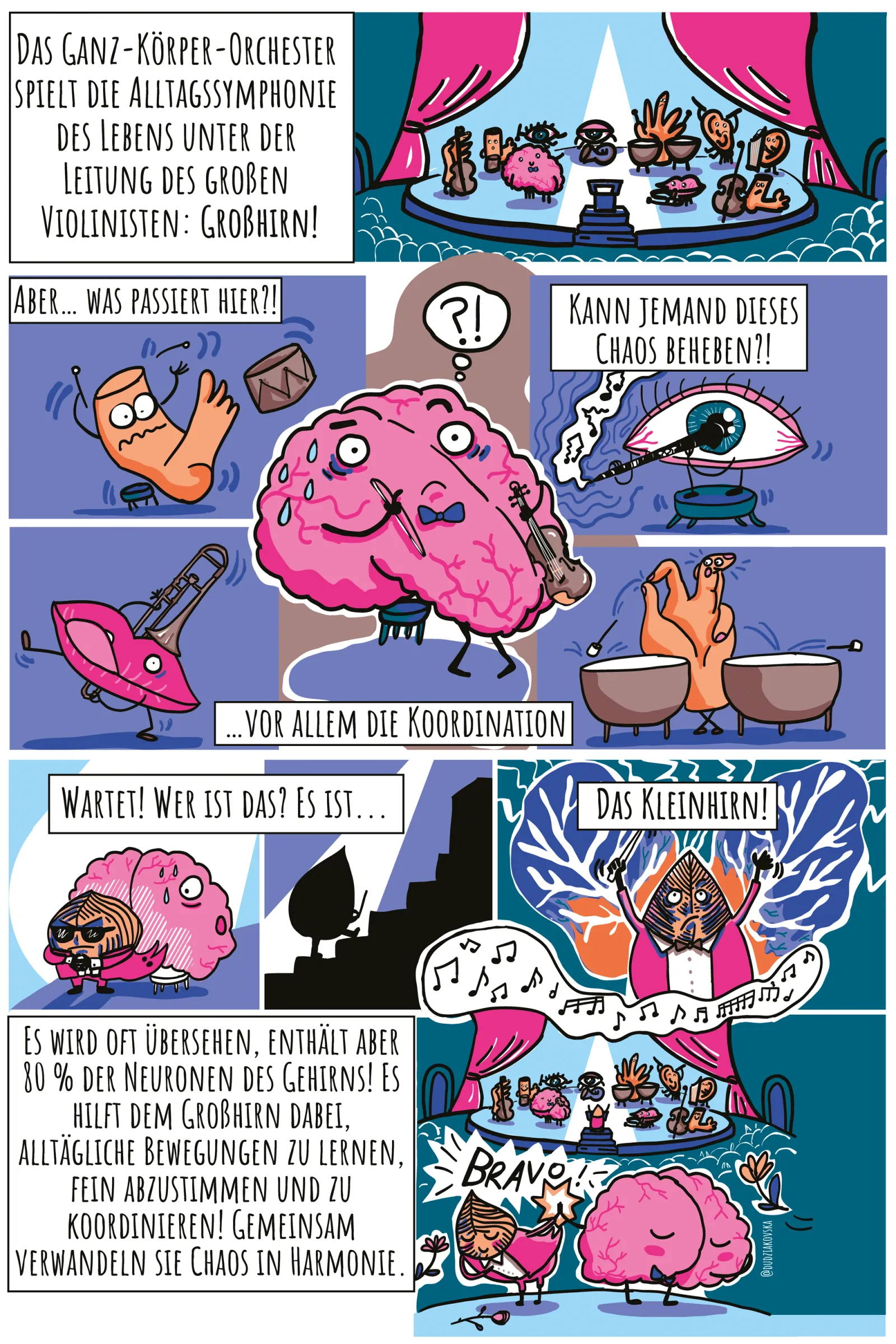
Our comic portrays the body as an orchestra performing the “symphony” of everyday life. Different body parts are shown as musicians, while the cerebral cortex (the “big brain”) acts as the lead violinist guiding the performance. Suddenly, the orchestra falls into chaos: instruments are out of sync, movements become uncoordinated, and confusion spreads across the stage.
The comic then introduces the cerebellum (the “little brain”) as the hidden conductor that restores harmony by coordinating timing, precision, and communication between all the musicians. Although the cerebellum is often overlooked, it contains around 80% of the brain’s neurons and is essential for learning, fine-tuning, and synchronizing movements and behaviors.
This reflects our research, which explores how the cerebellum plays a crucial role not only in movement coordination, but also in cognition, communication, and emotional regulation. The comic uses the orchestra metaphor to show that without the cerebellum, the body’s many talented “musicians” struggle to work together effectively.
What findings support this idea?
This claim is supported by a growing body of research showing that the cerebellum acts as a learning and correction system, constantly fine-tuning our thoughts, movements, emotions, and social interactions in real time. Although traditionally associated with movement and balance, scientists now know that the cerebellum contains specialized regions linked to multiple cognitive and emotional abilities. Through dense neuron connections with the rest of the brain, it helps coordinate and optimize many aspects of daily life.
Interestingly, research shows that the cerebellum plays a very important role in infancy and childhood. If the cerebellum is damaged early in life, it can contribute to long-term conditions such as autism, ADHD, and schizophrenia. However, damage occurring in adulthood often has less severe consequences. The timing makes an enormous difference because the cerebellum is crucial for “setting the stage” for the developing brain.
Studies from our lab show that the cerebellum is especially important for social behavior and communication, both in humans and, to some extent, in great apes. Our findings suggest that, during development and evolution, the cerebellum may help “teach” other brain regions how to perform these complex functions efficiently.
What are the limits and common misunderstandings?
Our findings do not mean that the cerebellum alone controls thinking, emotions, or behavior. The brain works as a highly interconnected system, and the cerebellum is only one (although very important) part of that system. Rather than acting as the brain’s sole “control center,” the cerebellum helps coordinate and fine-tune many brain functions. The cerebral cortex remains the brain’s main processing center, while the cerebellum acts more like an “external processor” that helps behaviors run smoothly through learning and correction.
Additionally, differences or damage in the cerebellum do not automatically cause conditions such as autism, ADHD, or schizophrenia. These conditions are complex and influenced by many genetic, developmental, and environmental factors. Overall, our research highlights the cerebellum’s important contribution to brain function, while also showing that it is one piece of a much larger puzzle.
What questions are still unanswered?
Many important questions about the cerebellum are still unanswered. Scientists are still trying to understand exactly how the cerebellum communicates with the rest of the brain, and which mechanisms it uses to fine-tune and coordinate behavior. The cerebellum is tightly folded like an accordion at the base of the skull, making it difficult to fully map all of its connections and communication pathways. As brain imaging and neuroscience technologies continue to improve, researchers hope to better understand how these circuits work.
It also remains an open question why the cerebellum seems much more important in early life than in adulthood. One of the biggest mysteries is why damage to the cerebellum in childhood can lead to severe and long-lasting difficulties in language and social behavior, whereas similar damage in adulthood often causes much milder effects. Researchers are still trying to understand exactly what role the cerebellum plays at different stages of life, especially during early brain development.
How could this shape future medicine?
Research on the cerebellum could contribute to the medicine of the future by changing how we understand, prevent, and treat neurological and psychiatric conditions. Traditionally, many conditions such as autism, ADHD, and schizophrenia were thought to mainly involve the cerebral cortex. However, growing evidence shows that the cerebellum also plays an important role. This opens the door to new treatment targets and therapeutic approaches. Instead of focusing only on the cerebral cortex, medical practitioners may also be able to target the “little brain” that helps fine-tune mental processes and behavior.
The cerebellum’s important role in early brain development is particularly significant. It highlights critical windows for intervention and the importance of protecting brain development during childhood. Understanding these developmental differences could lead to better strategies for the early prevention, diagnosis, and treatment of neurodevelopmental conditions.
For rehabilitation medicine, recognizing the cerebellum’s cognitive role also opens new possibilities for helping stroke patients, people with traumatic brain injuries, or those with neurodegenerative diseases. Therapies targeting the cerebellum, for example through targeted neurostimulation, may help improve movement, communication, and behavior.
What societal and ethical questions does this raise?
Research on the cerebellum raises important opportunities as well as ethical questions for society. Better understanding how the cerebellum contributes to thinking, emotions, and social behavior could improve rehabilitation, healthcare, and quality of life for many people. Athletes, musicians, and professionals requiring precise coordination may also benefit from training approaches that take the cerebellum into account.
At the same time, future therapies targeting the cerebellum, for example through neurostimulation or early-life interventions, raise important questions about safety, consent, accessibility, and how far society should go in modifying brain function and behavior. As we learn more about how the brain shapes cognition and behavior, it is important to ensure that these discoveries are used to support people rather than stigmatize differences in how brains work.
More broadly, this research challenges the traditional hierarchy of brain regions. Successful behavior is not simply about having a powerful cortex, but about different brain regions working together seamlessly. The cerebellum reminds us that some of the most important contributions happen quietly, behind the scenes, making everything else possible.
How do you study this topic?
We study the cerebellum using a combination of brain imaging, behavioral experiments, and computational methods. One of our main tools is magnetic resonance imaging (MRI), which allows us to examine the structure and activity of the brain in a non-invasive way. During MRI scans, participants often perform tasks, such as solving puzzles or watching movies, so that we can observe how different brain regions, including the cerebellum, are involved in behavior in real time.
We also study behavior outside the scanner using experimental tasks and questionnaires. These methods help us measure abilities such as language, social interaction, emotion processing, learning, and coordination. In addition, we analyze post-mortem brains from humans and great apes to better understand the microscopic structure and evolution of the cerebellum.
To bring these different types of data together, we use advanced computational statistics. By combining brain imaging, behavioral measurements, and computational approaches, we aim to better understand how the cerebellum contributes to everyday behavior across evolution and development in neurotypical and neurodivergent populations.
Where can I learn more about this topic?
Readers interested in learning more about the cerebellum and its role in behavior, cognition, and development can explore the following resources:
Podcasts and popular science articles
Podcast: Radiolab – Song of the Cerebellum
Blog post: What Does the Cerebellum Do Anyway?
News article: The Neuroscience of Superfluid Thinking
News article: Cerebellum sets the stage for children’s social abilities
Open-access scientific articles (including some of our own work)
Cerebellar role in different behaviors: Nature Neuroscience article
Cerebellar importance in development: Current Opinion in Behavioral Sciences article
Cerebellar role in language and social behavior: Nature Communications article
Cerebellar evolution: The Cerebellum article
Organizations and charities
Raynor Cerebellum Project: A charity dedicated to improving the lives of people with cerebellar conditions through research, awareness, and support.
Where it's set
About the Project
Science Streets ist ein Wissenschaftskommunikationsprojekt, das Wissenschaft in den Alltag bringt, indem es Leipzigs öffentliche Räume zu Lernorten macht. Für vier Wochen im August 2026 werden Science-Comics auf Werbeflächen (Litfaßsäulen, City-Light-Postern, Infoscreens, im öffentlichen Nahverkehr usw.) gezeigt. Das diesjährige Thema lautet Neurowissenschaften. Zehn Wissenschaftler*innen und zehn Illustrator*innen werden ausgewählt, um gemeinsam Comics rund ums Gehirn zu gestalten – die Wissenschaftler*innen liefern die Inhalte, die Illustrator*innen setzen diese künstlerisch um.
Videos
More Comics