Hormones Brain
Behind the comic
What is your research about - in one sentence?
We explore how fluctuations in ovarian hormones influence the brain, heart, body, and behaviour, and how these changes shape brain health across the lifespan.
What does the comic show?
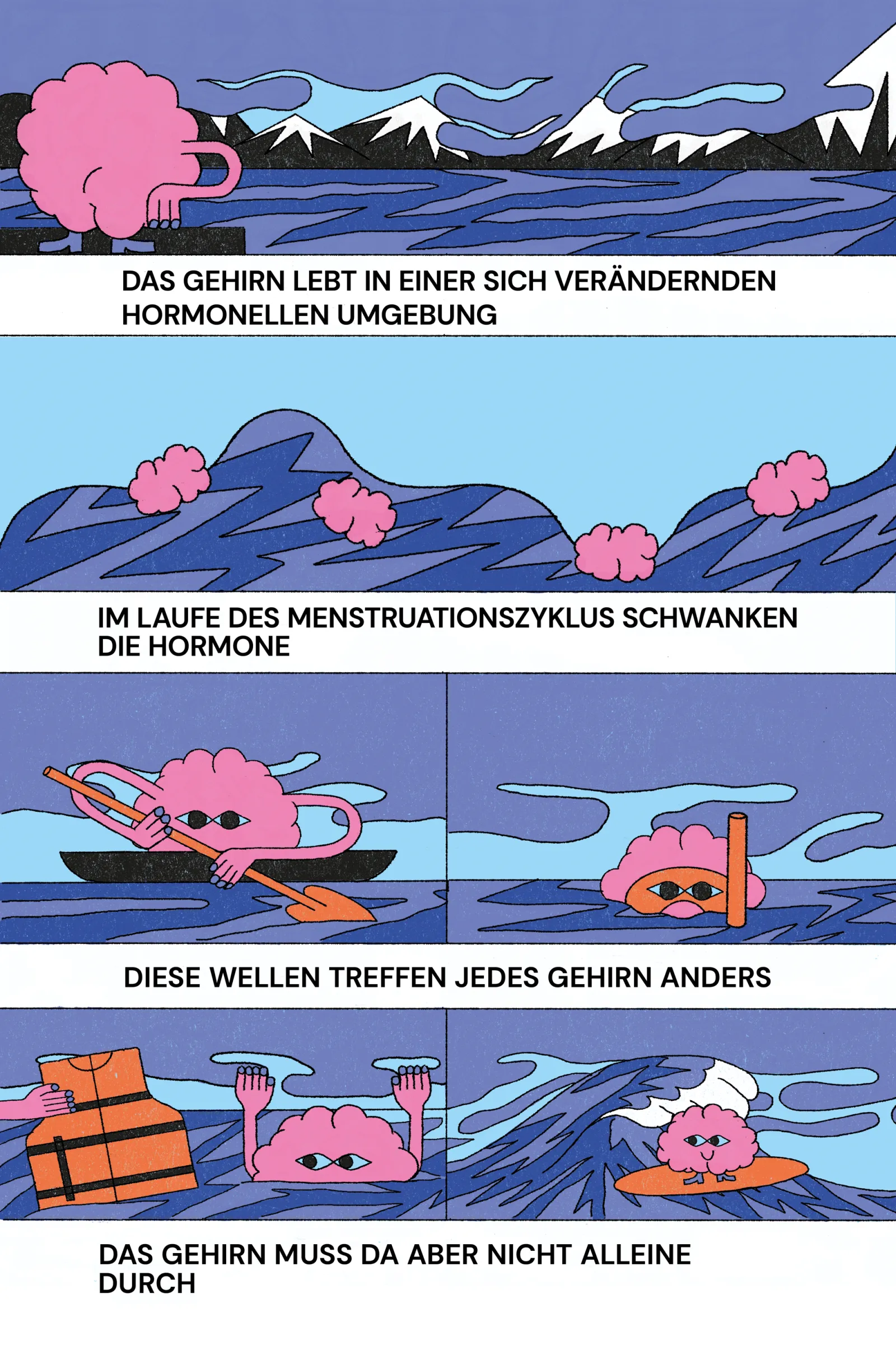
Across the lifespan, the brain is exposed to changing hormonal environments. Our comic focuses on the menstrual cycle, a period of regular hormonal fluctuations that occurs during the reproductive years between menarche, the first period, and menopause. Our comic illustrates how the brain can adapt to these hormonal changes. This adaptability is symbolized by different tools, such as a snorkel, surfboard, or paddle, which represent changes in brain structure and function that help the brain navigate changing hormonal conditions. Sometimes, however, the brain may need additional support. In the comic, a life vest represents resources and treatment that can promote well-being and ease symptoms, such as psychoeducation, peer support, psychotherapy, and medication. The comic highlights that hormonal changes affect everyone differently. Each brain may rely on its own set of tools, and these tools can change over time and across different stages of life.
What findings support this idea?
Our research shows that the brain can adapt remarkably well to changing hormone levels - a capacity known as neuroplasticity. This flexibility is reflected in changes across the brain and other body systems, including mood, stress responses, and heart function. They help maintaining emotional and physical well-being during both short-term hormonal fluctuations, such as those occurring across the menstrual cycle, and more persistent hormonal changes throughout life. When this ability to adapt is disrupted, it may contribute to cycle-related disorders.
We found that different parts of the hippocampus, a brain region particularly important for learning and memory, change in size parallel to fluctuations in estradiol and progesterone across the healthy menstrual cycle. Other studies have shown that hormones also influence how different brain regions communicate with each other.
We also found that the brain's serotonin system and the body's stress response change across the menstrual cycle. However, these changes follow a different pattern in individuals with premenstrual dysphoric disorder (PMDD), a condition that causes severe emotional and physical symptoms before menstruation.
What are the limits and common misunderstandings?
Our research challenges the long-standing misconception that ovarian hormones are too complex to study or merely introduce “noise” into research. This view has contributed to the persistent overrepresentation of male subjects in research and the generalization of findings to females despite important biological differences, limiting the development of female-specific diagnostics, treatments, and preventive care. We now know that hormonal environments are dynamic in everyone; they simply differ in their patterns. Our research shows that hormones are powerful biological signals that shape health across the lifespan.
Importantly, hormone-related changes in the brain do not mean that women are controlled by their hormones. Hormonal influences on the brain are not deterministic, and individuals differ substantially in how they experience and respond to hormonal changes. Our research examines how hormonal fluctuations relate to changes in mood and behavior in a nuanced way. By doing so, we aim to identify risk factors and promote resilience, rather than predict or explain individual behavior solely on the basis of hormones.
What questions are still unanswered?
Because females have historically been underrepresented in research and remain underrepresented in many areas today, we are still in the early stages of developing a fundamental understanding of how hormones shape brain and body health. In neuroimaging, for example, only 0.5% of studies involving human participants focus on women’s health. As a result, many questions still remain unanswered. We also know surprisingly little about how hormonal transitions across life - including puberty, the menstrual cycle, hormonal contraception, pregnancy, gender-affirming care, perimenopause, and aging - affect the brain and interact with other biological and social factors. This knowledge gap is particularly evident for female-specific conditions, such as polyendocrine metabolic ovarian syndrome (PMOS, previously known as PCOS) or endometriosis, and disorders that disproportionately affect females, including depression and Alzheimer’s disease. Expanding gender- and hormone-sensitive research improves diagnosis, treatment, and prevention while also advancing our broader understanding of human health. The unanswered questions are not hard to find - the challenge is deciding where to begin.
How could this shape future medicine?
Our work contributes to the development of more personalized medicine, recognizing that “one size does not fit all.” More precise, evidence-based, and individualized approaches to care are needed to improve treatment effectiveness and ensure that medical interventions are evaluated appropriately across diverse populations and are effective for each individual.
By improving our understanding of how hormonal changes influence the brain and body, our research may also support earlier recognition of risk factors and more targeted prevention strategies. In addition, increasing awareness of women’s health and sex differences in health outcomes can help reduce stigma, improve health care, and potentially save lives.
A key part of this effort is participation. Our research extends beyond data collection and includes public engagement, patient involvement, and collaboration with individuals with lived experience. This approach advances scientific understanding while empowering individuals to better understand their own bodies, make informed decisions, and take a more active role in their well-being.
What societal and ethical questions does this raise?
Research on hormones, brain, and female health offers an inclusive, representative, and intersectional perspective on human health. By expanding the definition of women’s health beyond reproduction, this work helps address important gaps in knowledge in women’s and gender-diverse health topics. Science and the way we communicate it should be accessible and comprehensive to everyone. Only then can scientific discoveries translate into benefits for society. Improving our understanding and awareness of these topics can reduce stigma, foster meaningful conversations about health, and empower individuals to make informed decisions about their own health and well-being. At the same time, research on biological differences must be communicated carefully to avoid reinforcing stereotypes or inequalities. Advancing women’s health is thus not only a scientific priority but also a matter of equity. Knowledge is power, and improving our gender-sensitive understanding of health, brain, and body is essential not only for those directly affected, but also for achieving better health outcomes for all.
How do you study this topic?
In our group, we investigate how the brain interacts with the cardiovascular, stress or immune systems. This means that we typically assess individuals using neuroimaging methods (MRI, PET, EEG), measure hormone levels (from blood or saliva), and assess markers of the immune system (via blood markers), stress (via salivary or behavioral markers) or cardiovascular system (via ECG). Typically, we study multiple phases of the menstrual cycle that differ in hormone levels and compare them. We do this either by comparing different individuals at different time points or by following the same individuals over time. The latter provides information on both changes within the same person and differences between individuals. Our goal is to understand how changes in hormones relate to changes in the brain, body, and behavior. To do this, we combine detailed measurements from individuals with larger studies involving many participants. Typically, we correlate hormone levels with the outcomes of interest, or test whether hormone levels predict the respective outcome.
References
Sacher, J., & Bechmann, I. (2025). Rethinking women's brain health. Nature reviews. Neuroscience, 26(10), 576–578. https://doi.org/10.1038/s41583-025-00969-4
Zsido, R.G., Williams, A.N., Barth, C. et al. Ultra-high-field 7T MRI reveals changes in human medial temporal lobe volume in female adults during menstrual cycle. Nat. Mental Health 1, 761–771 (2023). https://doi.org/10.1038/s44220-023-00125-w
Arélin, K., Mueller, K., Barth, C., Rekkas, P. V., Kratzsch, J., Burmann, I., Villringer, A., & Sacher, J. (2015). Progesterone mediates brain functional connectivity changes during the menstrual cycle-a pilot resting state MRI study. Frontiers in neuroscience, 9, 44. https://doi.org/10.3389/fnins.2015.00044
Ruehr, L., Hoffmann, K., May, E., Münch, M. L., Schlögl, H., & Sacher, J. (2025). Estrogens and human brainnetworks: A systematic review of structural and functional neuroimaging studies. Frontiers in neuroendocrinology, 77, 101174. https://doi.org/10.1016/j.yfrne.2024.101174
Sacher, J., Zsido, R. G., Barth, C., Zientek, F., Rullmann, M., Luthardt, J., Patt, M., Becker, G. A., Rusjan, P.,Witte, A. V., Regenthal, R., Koushik, A., Kratzsch, J., Decker, B., Jogschies, P., Villringer, A., Hesse, S., & Sabri, O. (2023). Increase in Serotonin Transporter Binding in Patients With Premenstrual Dysphoric Disorder Across the Menstrual Cycle: A Case-Control Longitudinal Neuroreceptor Ligand Positron Emission Tomography Imaging Study. Biological psychiatry, 93(12), 1081–1088. https://doi.org/10.1016/j.biopsych.2022.12.023
Hoffmann, K., Zsido, R. G., Villringer, A., Hesse, S., Sabri, O., Engert, V., & Sacher, J. (2025). Exploring the cortisol awakening response in premenstrual dysphoric disorder and in healthy females across the menstrual cycle. The British Journal of Psychiatry, 1–9. doi:10.1192/bjp.2025.10432
Jacobs E. G. (2023). Only 0.5% of neuroscience studies look at women's health. Here's how to change that. Nature, 623(7988), 667. https://doi.org/10.1038/d41586-023-03614-1
May, E., Comasco, E., Tiepolt, S., Strauß, M., Kundakovic, M., Hesse, S., Sabri, O.,Villringer, A., Sacher, J. (2026). Timing matters: Leveraging positron emission tomography imaging and hormonal cycles for precision psychiatry in female mental health. Biological Psychiatry 99 (9), pp. 713 - 727 (2026)
Prinsen, J., Villringer, A., & Sacher, J. (2025). The monthly rhythm of the brain-heart connection. Science advances, 11(10), eadt1243. https://doi.org/10.1126/sciadv.adt1243
Where it's set
About the Project
Science Streets ist ein Wissenschaftskommunikationsprojekt, das Wissenschaft in den Alltag bringt, indem es Leipzigs öffentliche Räume zu Lernorten macht. Für vier Wochen im August 2026 werden Science-Comics auf Werbeflächen (Litfaßsäulen, City-Light-Postern, Infoscreens, im öffentlichen Nahverkehr usw.) gezeigt. Das diesjährige Thema lautet Neurowissenschaften. Zehn Wissenschaftler*innen und zehn Illustrator*innen werden ausgewählt, um gemeinsam Comics rund ums Gehirn zu gestalten – die Wissenschaftler*innen liefern die Inhalte, die Illustrator*innen setzen diese künstlerisch um.
Videos
More Comics