Memory
Behind the comic
What is your research about - in one sentence?
We study how young children form, retain, and forget memories in their second year of life.
What does the comic show?
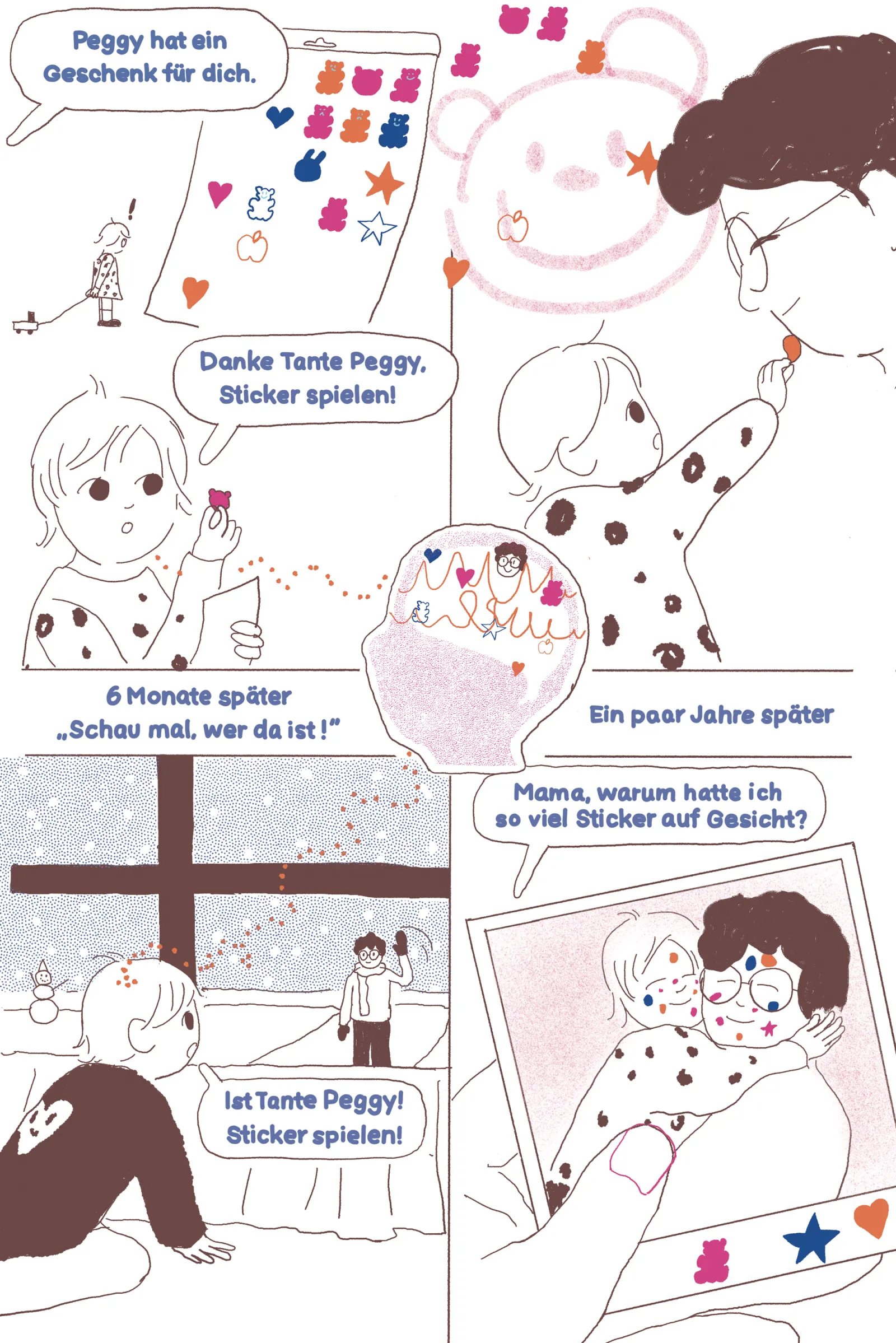
Our comic illustrates the phenomenon of infantile amnesia - the inability to recall episodic memories from early childhood. It follows a young child playing a sticker game with her aunt Peggy. As they play, her brain forms a memory of this specific experience. Several months later, she is still able to remember the game and retrieve details of the event, supported by measurable patterns of brain activity. This reflects our finding that memories formed in toddlerhood can persist for much longer than previously thought. Years later, however, the same memory is no longer accessible. When she sees the stickers again, she recognises them but cannot remember the original event or how they got there. The comic highlights a central mystery of infantile amnesia: early memories may be stored in the brain, yet become inaccessible later in life.
What findings support this idea?
Although most people cannot remember anything from their first years of life, research shows that infants and toddlers are incredible learners: They can recognize familiar faces, imitate actions they have seen, and remember simple stories for weeks.
This creates a paradox: early in life, memories can clearly be formed and retained, yet they are not available to us later on. One explanation for this is that early memories are not completely lost, but become harder to access as the brain develops. During the first years of life, the brain regions important for memory, such as the hippocampus, undergo rapid growth and reorganization, which may affect how earlier experiences are stored and retrieved. Supporting this idea, studies in animals suggest that early life memories can still be artificially reactivated by stimulating certain parts of the brain.
What are the limits and common misunderstandings?
Infantile amnesia specifically affects episodic memory our conscious, recollective memory for personal past events. Our study uses a very specific learning situation in which toddlers play a structured hide-and-seek game with carefully controlled instructions and stimuli that cannot be found outside the lab. This setup allows precise assessment of certain components of episodic memory, but it does not reflect children’s real-world experiences. Thus, whether performance on our task reflects full episodic memory in the richest sense remains an open question. Because of this, our findings cannot be directly generalised to all types of childhood memories. In particular, we cannot conclude that toddlers remember everyday events in the same way, or for the same duration, outside of a laboratory setting. A further important point is that our results show whether children can successfully retrieve a learned association at a later time, but they do not reveal what happens to memories when they are no longer accessible. We therefore cannot say whether forgotten early memories are still stored somewhere in the brain or whether they are completely lost.
What questions are still unanswered?
A central open question in infantile amnesia research is whether early memories are truly lost over time, or whether they remain stored in the brain but become inaccessible — a retrieval deficit. Our study shows that memories formed in toddlerhood can persist for months, with both behavioural and neural signatures intact. However, because children performed surprisingly well in our task, we did not observe the full trajectory of forgetting, and so our data cannot directly address what happens to these memories once they do become inaccessible. Thus, it remains unknown whether animal research findings showing reactivation of „lost“ childhood memories can be replicated in humans and if so, what conditions would allow such reactivation to occur. Answering this question has broad implications: if infantile amnesia reflects a retrieval deficit rather than storage failure, it would suggest that our earliest experiences may leave lasting traces in the brain, even when they can no longer be consciously recalled.
How could this shape future medicine?
Understanding how early memories are formed and later become inaccessible can give us better insight into how human memory develops in the first years of life. This knowledge can guide the design of early learning environments and help parents and caregivers support healthy memory development through age-appropriate activities, routines, and playful learning. Another important application is the early identification of developmental or neurological disorders that affect memory and learning. In the long term, such insights could contribute to more individualised intervention and educational approaches. More broadly, studying infantile amnesia may also inform research on memory loss later in life, including the pathological forgetting of past experiences often seen in dementia. While these are very different contexts, understanding how memory accessibility changes early in life may help refine general models of how memories are stored and retrieved across the lifespan.
What societal and ethical questions does this raise?
Research on early memory development can change how we think about learning in the first years of life. Our findings suggest that very young children are already capable of forming lasting memories, which may have implications for how we structure early education, caregiving, and everyday interactions with infants and toddlers. This could support more informed decisions about when and how to introduce certain types of experiences or learning activities. At the same time, these findings raise ethical questions worth considering. If early experiences leave lasting neural traces — even ones that cannot be consciously recalled — this underscores the importance of safe, nurturing environments in the earliest years of life.
How do you study this topic?
We study episodic memory development using a playful hide-and-seek game designed for toddlers. In this task, children learn that a specific toy is always hidden in a particular location within a given environment. This allows us to test whether they can later remember and use this information to find the toy again. To capture how children behave during the task, we record their movements on video and analyse their search trajectories in detail. In addition to behavioural observation, we use mobile electroencephalography (EEG) to measure what children’s brains are doing while they form and retrieve these memories. Together, these methods allow us to link children’s behaviour with their brain activity during memory formation and retrieval in a naturalistic yet controlled setting.
Where can I learn more about this topic?
In this radio recording, you can hear a recording of a toddler doing our task: https://www.deutschlandfunk.de/fruehkindliche-amnesie-kindheitserinnerung-wie-gedaechtnis-entsteht-100.html
Here, you can learn more about the broader research field of infantile amnesia: https://www.science.org/content/article/are-your-earliest-childhood-memories-still-lurking-your-mind-or-gone-forever
References
Animal studies that show reactivation of infantile memories
Guskjolen et al. (2018), Current Biology, https://doi.org/10.1016/j.cub.2018.05.059
Power et al. (2023), Science Advances, https://doi.org/10.1126/sciadv.adg9921
Review articles on infantile amnesia:
Alberini & Travaglia (2017), The Journal of Neuroscience, https://doi.org/10.1523/JNEUROSCI.0324-17.2017
Li et al. (2014), Learning & Memory, https://doi.org/10.1101/lm.031096.113
Madsen & Kim (2016), Behavioural Brain Research, https://doi.org/10.1016/j.bbr.2015.07.030
Articles on cross-species research in the field of early memory development
Bevandić et al. (2024), Neuron, https://doi.org/10.1016/j.neuron.2024.01.020
Where it's set
About the Project
Science Streets ist ein Wissenschaftskommunikationsprojekt, das Wissenschaft in den Alltag bringt, indem es Leipzigs öffentliche Räume zu Lernorten macht. Für vier Wochen im August 2026 werden Science-Comics auf Werbeflächen (Litfaßsäulen, City-Light-Postern, Infoscreens, im öffentlichen Nahverkehr usw.) gezeigt. Das diesjährige Thema lautet Neurowissenschaften. Zehn Wissenschaftler*innen und zehn Illustrator*innen werden ausgewählt, um gemeinsam Comics rund ums Gehirn zu gestalten – die Wissenschaftler*innen liefern die Inhalte, die Illustrator*innen setzen diese künstlerisch um.
Videos
More Comics