Touch
Behind the comic
What is your research about - in one sentence?
We want to understand how touch influences our relationships over time, and the biological processes that happen in the brain and body to fuel these changes!
What does the comic show?
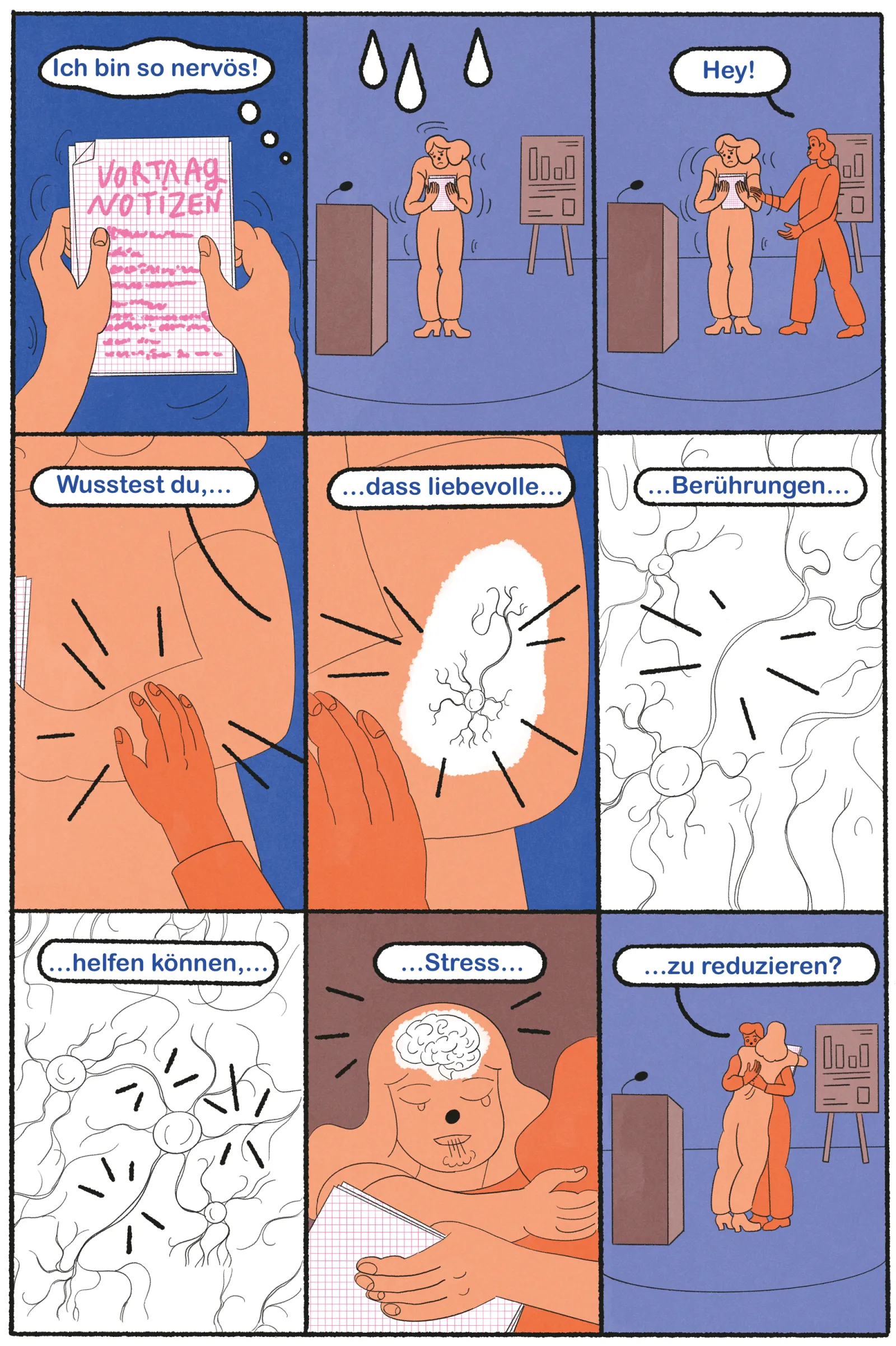
We wanted to capture a familiar situation, to show just how ubiquitous touch is in our everyday lives. Affectionate touch is a simple act, but it powers a myriad of communication signals the nervous system that can help us to feel a sense of calm and reduce our stress levels.
We have a unique cell in our skin, called the C-tactile fibre, whose sole function is to respond to gentle touch, which is depicted in the comic. When this C-tactile fibre is stimulated, a message travels all of the way to the brains social and emotional centres. The brain reacts by instructing the body to increase release of a hormone called oxytocin, which strengthens feelings of calm and trust. The brain also sends instructions to reduce cortisol, as well as reducing heart-rate and blood pressure. All of these are involved in the stress response, meaning that touch can support in reducing our stress levels, and improving our sense of calm and trust! So, hugs really do make us feel better! Magical!
However, it’s a bit more complicated than, everyone hugging all the time to achieve world peace (although that would be nice!). Touch from a stranger can trigger a different cascade of hormone release compared to touch from romantic partner or friend. Most of the research up until now has only looked at touch in romantic couples OR in complete strangers. Between these two extremes, not that much work has been carried out. We also don’t really know how this changes over time, either – At what point, does a stranger become a partner? And do we see a sudden dramatic change in hormones at some point, or is it more gradual? This what our research is currently trying to find out.
What findings support this idea?
The fact that c-tactile fibres exist is by now, well documented. What is not depicted in the comic is just how fussy C-tactile fibres are! They will only get awakened under certain conditions: the temperature of the stroking needs to be around 32 degrees – which just so happens to be the exact temperature of human skin. The stroking also needs to happen at a certain speed – around 3cm per second. However, humans seem to be very intuitive in this sense; one study filmed new mothers in a waiting room and found that they instinctively stroked babies at exactly this speed!
The hormone fluctuations that occur during affectionate touch are also well researched. However, these change a bit depending on the relationship between two individuals. Generally, touch from a partner feels good, increases oxytocin, and reduces cortisol. On the other hand, touch from a stranger can actually increase cortisol. Given the social context, this makes sense, as it mirrors the increased trust and affinity that humans show in partners, compared to strangers.
Friendships, which are less well studied also show some contradictory findings. We think that this is probably due to factors such as personality, attachment, and the quality of friendship. For example, do neurotic people feel less comfortable with touch? Do people with secure attachment styles perceive touch as more caring? There is some emerging research on this, but we don’t have the full answers yet!
What are the limits and common misunderstandings?
Oxytocin has been depicted in the media as the ‘love hormone’. Although rooted in the right ideas, this is a vast oversimplification. Oxytocin’s outcomes are dependent on many factors.
For example, the person involved is important. Although oxytocin generally increases feelings of trust and affection to those we already care about, it may actually reduce feelings of trust and affection towards strangers. Studies in prairie voles actually showed that subspecies with high oxytocin are more monogamous – so reserving their love and affection for just one special other prairie vole!
There is also research showing that infants who grow up under adverse circumstances, such as that of parental abuse, can develop a disrupted oxytocin system, meaning that the oxytocin system does not function in the way it’s supposed to. In some individuals with mental health issues – such as borderline personality disorder – we see decreases in prosocial behaviour and trust following a dose of oxytocin.
In relation to touch, our lab showed that the order of social interaction is important. If a participant received touch from a partner first, they showed increased oxytocin release, and this also meant that the oxytocin released was higher when they received follow up touch from a stranger. However, when receiving touch from a stranger first, the participant showed cortisol increases which did not return to baseline when receiving follow up touch from their partner.
What questions are still unanswered?
Lots of questions! Like mentioned before, most of the research up until now has only looked at touch in romantic couples OR in complete strangers. We don’t really know much about friendships, situationships etc. We also don’t yet understand how these fluctuations change across the relationship. At the moment we are trying to answer the question ‘How and when does a stranger become a partner?’. We want to create a huge speed dating event and follow up all of the matches repeatedly, to see how their hormones fluctuate when engaging in affectionate touch! It would be so cool to see how touch, oxytocin and cortisol influence each other at every stage of the romantic relationship!
Beyond this, there is emerging research in autism, and neurodiversity in general. Generally, people with autism may have an altered response to touch compared to neurotypical individuals, with a lot of autistic individuals expressing discomfort with touch. However, across time, more frequent every day touch seems to be associated with reduced stress, and increased coping skills in autism. This is a bit contradictory, so more work needs to be carried out to fully understand what is going on here.
As with most scientific research right now, AI is influencing our research decisions and questions. For example, the use of AI, robots and the future of touch therapies is an avid field of research right now. It’s very exciting, but a lot of people are worried that these things can’t fully replace human touch and interaction.
How could this shape future medicine?
In our lab, we are mainly looking at how touch works, rather than future implications. So, this doesn’t directly relate to medicine. However, as mentioned before, clinical and neurodivergent populations, such as autistic individuals and those with borderline personality disorder seem to have different responses to touch. So, understanding how they respond to touch will hopefully lead to better touch-related therapies in the future!
Also, as depicted in the comic, touch is inherently beneficial in the face of stress. This is already well validated in the research. But like many more holistic therapies, it has been difficult for this to be really taken seriously, despite the scientific research catching up with what alternative and hollistic communities have been saying for years. Therapies such as massage, and other touch therapies can be a really beneficial tool but integrating them into mainstream medicine is taking some time.
What societal and ethical questions does this raise?
One example of perhaps not an ethical challenge, but definitely a dilemma, was during the pandemic. During covid, we saw that multi-person households who were more frequently engaging in affective touch had better mental health outcomes, lower overall cortisol and higher oxytocin levels. It was a really difficult time for much of the population, and not being able to engage in touch or close contact actually made a lot of things worse. If you have chronically high cortisol, this can lead to a weakened immune system. So, it was a bit of a double-edged sword. If we spent time close to people, we increased covid chances. But if we didn’t experience any affective touch, it was also bad! Self-soothing touch, pets, weighted blankets and even robots can act as reasonable substitutes, and exploring this in the future will be a really interesting avenue, especially in the face of future endemics and pandemics.
More generally, western countries are becoming more and more individualistic. Especially in the US we are seeing a dearth of third spaces, as well as increasing single households. Whilst there are of course benefits to independence, loneliness rates are soaring. We see that in many collectivist cultures, touch is much more commonplace. However, with increased touch, we also see instances of increased unwanted touch. It is very difficult to balance all of this, and even more to guide policy on how and when people should be interacting. We can’t legally tell people that they should live in multi-person households and hug 8 times a day because it’s better for them! One of the ways we can help is by educating, and guiding the population with the right information at hand, which is why science streets is such a wonderful initiative!
How do you study this topic?
In lots of different ways! Because touch should be at around 3cm per second, we train everyone who comes into the lab how to arm-stroke properly at this speed, using the correct pressure, etc etc. Understandably, all the lab members who have carried out experiments have perfected this. Once we were comparing touch from a stranger (the stranger usually being one of the lab members!) compared to that of a partner. I remember one participant sheepishly admitting ‘Obviously I prefer the touch from my boyfriend.. but the experimenter had such a great technique!’.
We use a range of methods to explore the effects of touch. For example, we put people in a big magnet, called a functional magnetic resonance imaging (fMRI) machine, to measure real-time changes in the brain. To look at hormones we use blood or saliva samples, depending on what exactly we want to see. Each hormone has slightly different levels in the blood and saliva, and we tend to see changes in hormones more quickly in saliva. Generally, we use saliva to look at quick changes, and blood to look at overall levels of hormones – this is especially the case for cortisol, but it really varies a lot, hormone to hormone. We also use heart monitors to look at changes in heart activity.
Of course, self-report data is always really important. Physiology can tell us a lot, but if we pair it with what a participant is telling us, for example, how stressed they feel, how comforted they feel, we can really begin to draw a bigger picture. Sometimes we see a very clear picture: If the participant is telling us they are stressed, their cortisol is high, and parts of the brain involved in the stress response are activated then we can be pretty sure that this is a reliable stress response. But there is often discordance between all of these, which we have to interpret a little deeper down the line. This can get very complicated!
Where can I learn more about this topic?
Social Media Account: I have an Instagram account where I share information about my work, but also more generally around neuroscience and women’s health @braincox_
Book: When we touch – Michael Banissy, https://www.hachette.co.uk/titles/michael-banissy/when-we-touch/9781398708723/#:~:text=His%20groundbreaking%20new%20book%20explains,help%20us%20feel%20less%20pain. A great overview of the neuroscience of touch!
Book: Heart, hand and head – India Morisson (Publication pending!) Another great overview of the neuroscience of touch, and our evolutionary story. It will be out next year!
Article: Why humans and animals rely on social touch https://www.bbc.co.uk/future/article/20131014-the-touching-moments-we-all-need
References
Article: The brain reacts differently to touch based on context https://liu.se/en/news-item/the-brain-reacts-differently-to-touch-depending-on-context
Journal Article: Handlin, L., Novembre, G., Lindholm, H., Kämpe, R., Paul, E., & Morrison, I. (2023). Human endogenous oxytocin and its neural correlates show adaptive responses to social touch based on recent social context. eLife, 12, e81197. https://doi.org/10.7554/eLife.81197
Journal Article: Olff, M., Frijling, J. L., Kubzansky, L. D., Bradley, B., Ellenbogen, M. A., Cardoso, C., Bartz, J. A., Yee, J. R., & van Zuiden, M. (2013). The role of oxytocin in social bonding, stress regulation and mental health: an update on the moderating effects of context and interindividual differences. Psychoneuroendocrinology, 38(9), 1883–1894. https://doi.org/10.1016/j.psyneuen.2013.06.019
Where it's set
About the Project
Science Streets ist ein Wissenschaftskommunikationsprojekt, das Wissenschaft in den Alltag bringt, indem es Leipzigs öffentliche Räume zu Lernorten macht. Für vier Wochen im August 2026 werden Science-Comics auf Werbeflächen (Litfaßsäulen, City-Light-Postern, Infoscreens, im öffentlichen Nahverkehr usw.) gezeigt. Das diesjährige Thema lautet Neurowissenschaften. Zehn Wissenschaftler*innen und zehn Illustrator*innen werden ausgewählt, um gemeinsam Comics rund ums Gehirn zu gestalten – die Wissenschaftler*innen liefern die Inhalte, die Illustrator*innen setzen diese künstlerisch um.
Videos
More Comics